When I was younger the word resume confused the hell out of me. To resume is to start something after stopping it, and I could never make the connection between that definition and job searching. Once I finally figured out the difference between the two, I came to realize that the French version of the word applies a whole lot more to my life than the English one. Building the perfect resume (that's how I'm going to represent the word because I don't know how to add accent marks on this computer) has become somewhat of an obsession in our busy, competition-driven world. There are far too many applicants applying for the same jobs, so managers need some way to differentiate the candidates they want from the ones they don't. This is why it has become crucial for us millennials to perfect our resumes down to the very last detail, regardless of how insignificant that detail may seem. Here's what we've been told (or at least what I've heard from my limited experience adulting): Your resume can only be one page, unless you have a ton of experience or you've been out of college for x amount of time, and it has to be a certain font (not too big but also not too small!), and the formatting has to be completely uniform with all of the bullet points perfectly lined up and maybe use a font different from Times New Roman but not too different because you don't want to get too fancy, which is also why you shouldn't put any special borders around the edges, and make certain that the information you put relates directly to the occupation in question but don't steal the exact wording of the job posting because that's lazy and unprofessional, which is also why its absolutely IMPERATIVE that you customize your resume to fit the specific posting you're responding to even if that means making micro-changes that don't really make a difference but are still necessary because it shows that you are adaptable and understand how to satisfy requirements, and don't use an objective statement, unless of course you take RWS 290 in which you are expressly informed to use an objective statement (???), but really in the end its most important to be genuine and honest about your accomplishments while still adding a little extra flare a.k.a. lie about what you've done but be subtle about it. I think you get my point. There are millions of conflicting views about millions of different requirements needed to make the ultimate resume, combining to form a thick stew of confusion and anxiety.
To combat the perplexing nature of the UR (ultimate resume)(I've been using parentheses too much and should probably attempt to integrate these parenthesized thoughts into my blog without using them so much, but its kinda becoming a theme so I'll keep doing it), it seems as though the best option is to follow basic suggestions and leave the rest up to trial and error. If I keep formatting my resume a certain way, and I'm not getting any call-backs, then that tells me one of two things: I'm not formatting it optimally, or I'm just not qualified for the job. Simple as that. Without personal, real-world experience, the reality is that nobody knows exactly how to create the UR. Every manager has different expectations when it comes to qualification and presentation, so the only way to find out what kind of resume works for you is to make one and put it out there.
The very first time I created a resume was in RWS 290 last year. The reason I hadn't previously created one was that the only position I had ever held was at Baskin Robbins, and that's because they were severely understaffed and my Dad knew one of the co-managers. No resume needed. Also, I was an 8th grade girls volleyball coach once but that's because nobody else wanted to do it and I needed some spending money. Anyway, since my resume is so new, I haven't really gone through the aforementioned trial and error necessary to determine whether or not I have a good resume. The way I see it, my resume is decent because I was given instruction from a professor that seemed to know what he was talking about (except for the part about the objective statement, I guess), but it certainly hasn't approached UR territory yet. The first semester of my junior year is about to come to a close, which means its time for me to start sending out some feelers to get a sense of where I stand. I will most definitely be looking to land an internship in San Diego for the summer, and I hope that with enough guidance and practice I can turn that thick stew into something more manageable.
Tuesday, November 15, 2016

Monday, October 24, 2016
Where Am I Headed
I'm a pretty indecisive person in general, so choosing a discourse community to study is being difficult for me. Its also even harder to think of what to write about without the prompt being based on a reading. I have a few ideas so far, not sure if I'll end up going with any of them. Being that I am a huge sports fan, I was think about choosing some type of team. I already wrote an entire blog about why a sports team is a discourse community, so in that sense I've already made some progress. One of my friends is on the club soccer team here at San Diego State, so I could narrow my community down to soccer teams and use his team to research. Having been on several basketball and volleyball teams, I know what being on a team is like. However, every group of people is different and I would love to see how the dynamic plays out when it comes to soccer, a sport I am not quite as familiar with. It will be very interesting seeing how they interact with each other and how the coach communicates with them, and then comparing that to my experiences. I have a general feel for this type of community but there is so much more to learn.
I just had an idea. Staying on the topic of sports, I think a pretty cool discourse community to look at would be intramural referees. I already know a ton about sports, but I have never had experience reffing. Everybody is quick to criticize referees, and not many people put thought into how difficult the job is or what preparation goes into performing this duty. A friend of mine is one of the head intramural refs, and he is always talking about something new that happened at one of his games. One of the refs cried today, I had to call security on some fans tonight, blah blah blah. It sounds interesting. Having viewed and played in so many games, I understand typical calls that are made, but not how referees communicate with each other or what procedures they follow.
I understand that the focus of this paper is not to talk about how great the community in question is, but I think I will have a more enjoyable experience if I am interested in the topic. In order to research I will need to go the Aztec Recreation Center and watch several different games in order to study the ways referees communicate with each other. Look at their body language, gauge their emotions, and pay attention to what they might be talking about during timeouts or halftime. I can also interview my friend along with some of his coworkers. Obviously, these refs interact in ways far different from how everyday people talk. They must remain professional and stick with business at all times, but the moods they are in will probably depend on the score of the game and how they have been doing throughout the game.
In the prompt for this blog there are a bunch of questions about the discourse community, and I'm not sure if we are supposed to answer them in this blog or if they are just examples for us to keep in mind for the essay. I think its the latter considering I'm not going to know any of the questions without conducting further research. While I do have some knowledge of both communities going into this assignment, I still don't think its going to be easy. There are so many details and intricacies to focus on, and I don't think my prior knowledge will give me a huge advantage. Overall, I'm pretty excited to do this assignment. As indecisive as I am, getting to choose my own community that I'm actually interested in makes me that much more ready to put some serious work in.
Wednesday, October 19, 2016
Wardle and Work
Being that I am still not sure what I want to do with my career, this might be a tough prompt for me to write about. I am currently an accounting major but I'm thinking about switching some time in the near future. To what, I'm not sure. This being said, I'll just assume that I will have some sort of business related occupation. I'll start by talking about the internship I had this summer. At the beginning of break I was searching as hard as I could for an entry-level internship, but was having no luck. I don't have much work experience so it was being tough for me to get some calls back. I could have just applied for a restaurant or retail place, but I figured it would be a better idea to try to gain some experience in my field of interest. Finally, one of my friends told me that their dad was looking to hire somebody to be an intern at his consulting firm. This seemed like a great opportunity, so I jumped on it.
The office environment was completely different from what I'm used to. I had to dress up in business casual attire, stay diligent, and most importantly, be professional. As a person my natural instinct is to do things slowly. I talk pretty slowly and my movements generally are not as up tempo as a lot of other people. I soon found that sleep-walking through the day was not something I could do at this new job. I was a part of a system bigger than myself, and I needed to carry my weight. I made a conscious attempt to be more energized (with the help of coffee, of course), and tried to get as much work done in as little time as possible. The only problem with this experience was that I was pretty much only doing grunt work the entire time. This included scanning documents and copying/pasting stuff into excel. Not the most fun job in the world but I made some money and its something to put on my resume.
It was amazing to me how different my identity became once I stepped into the office. It wasn't like we were forbidden to talk or joke around every once in a while, but the intensity and pressure of pulling my weight definitely caused me to become a lot different of a person. I would get home from work and hang out with my friends, and every night I would feel myself decompressing and releasing all the stress from the day. I can imagine this is how a lot of people feel after a hard day's work. Once I get into the real world, I can see this new identity becoming an even bigger part of my life. More responsibilities, more stress, and more productivity. I think if I finally get in the habit of being productive and getting my stuff done early, that will free up a lot of my time and I won't have to worry about deadlines hanging over my head like a storm cloud.
If I do end up sticking with accounting, I will definitely have to adjust the way I naturally write. First of all, accounting is all about getting rid of all the fluff and getting straight to the point. Balance this, balance that, and what do we have. When writing reports to upper management, they aren't going to want to read a novel about the company's financial statements. They have too much on their plate to deal with that. They are going to want a short, to the point summary. This is something I'm going to need to get used to. In school we have been taught only the five-paragraph essay format, something that won't really help for being an accountant. Instead, I need to be able to pick out the main points, and organize them in a clear, concise way. Honestly, this is part of the reason I am thinking about switching. I want to find a business related occupation that also allows me to write in creative ways. This way, my writing preferences will be satisfied and I still get to fulfill my goal of making it in the business world. This may be a pipe dream, but in today's world there are so many options and routes to take that I think I will be able to figure it out somewhere along the way.
The office environment was completely different from what I'm used to. I had to dress up in business casual attire, stay diligent, and most importantly, be professional. As a person my natural instinct is to do things slowly. I talk pretty slowly and my movements generally are not as up tempo as a lot of other people. I soon found that sleep-walking through the day was not something I could do at this new job. I was a part of a system bigger than myself, and I needed to carry my weight. I made a conscious attempt to be more energized (with the help of coffee, of course), and tried to get as much work done in as little time as possible. The only problem with this experience was that I was pretty much only doing grunt work the entire time. This included scanning documents and copying/pasting stuff into excel. Not the most fun job in the world but I made some money and its something to put on my resume.
It was amazing to me how different my identity became once I stepped into the office. It wasn't like we were forbidden to talk or joke around every once in a while, but the intensity and pressure of pulling my weight definitely caused me to become a lot different of a person. I would get home from work and hang out with my friends, and every night I would feel myself decompressing and releasing all the stress from the day. I can imagine this is how a lot of people feel after a hard day's work. Once I get into the real world, I can see this new identity becoming an even bigger part of my life. More responsibilities, more stress, and more productivity. I think if I finally get in the habit of being productive and getting my stuff done early, that will free up a lot of my time and I won't have to worry about deadlines hanging over my head like a storm cloud.
If I do end up sticking with accounting, I will definitely have to adjust the way I naturally write. First of all, accounting is all about getting rid of all the fluff and getting straight to the point. Balance this, balance that, and what do we have. When writing reports to upper management, they aren't going to want to read a novel about the company's financial statements. They have too much on their plate to deal with that. They are going to want a short, to the point summary. This is something I'm going to need to get used to. In school we have been taught only the five-paragraph essay format, something that won't really help for being an accountant. Instead, I need to be able to pick out the main points, and organize them in a clear, concise way. Honestly, this is part of the reason I am thinking about switching. I want to find a business related occupation that also allows me to write in creative ways. This way, my writing preferences will be satisfied and I still get to fulfill my goal of making it in the business world. This may be a pipe dream, but in today's world there are so many options and routes to take that I think I will be able to figure it out somewhere along the way.
Tuesday, October 18, 2016
Waitress Lives Matter
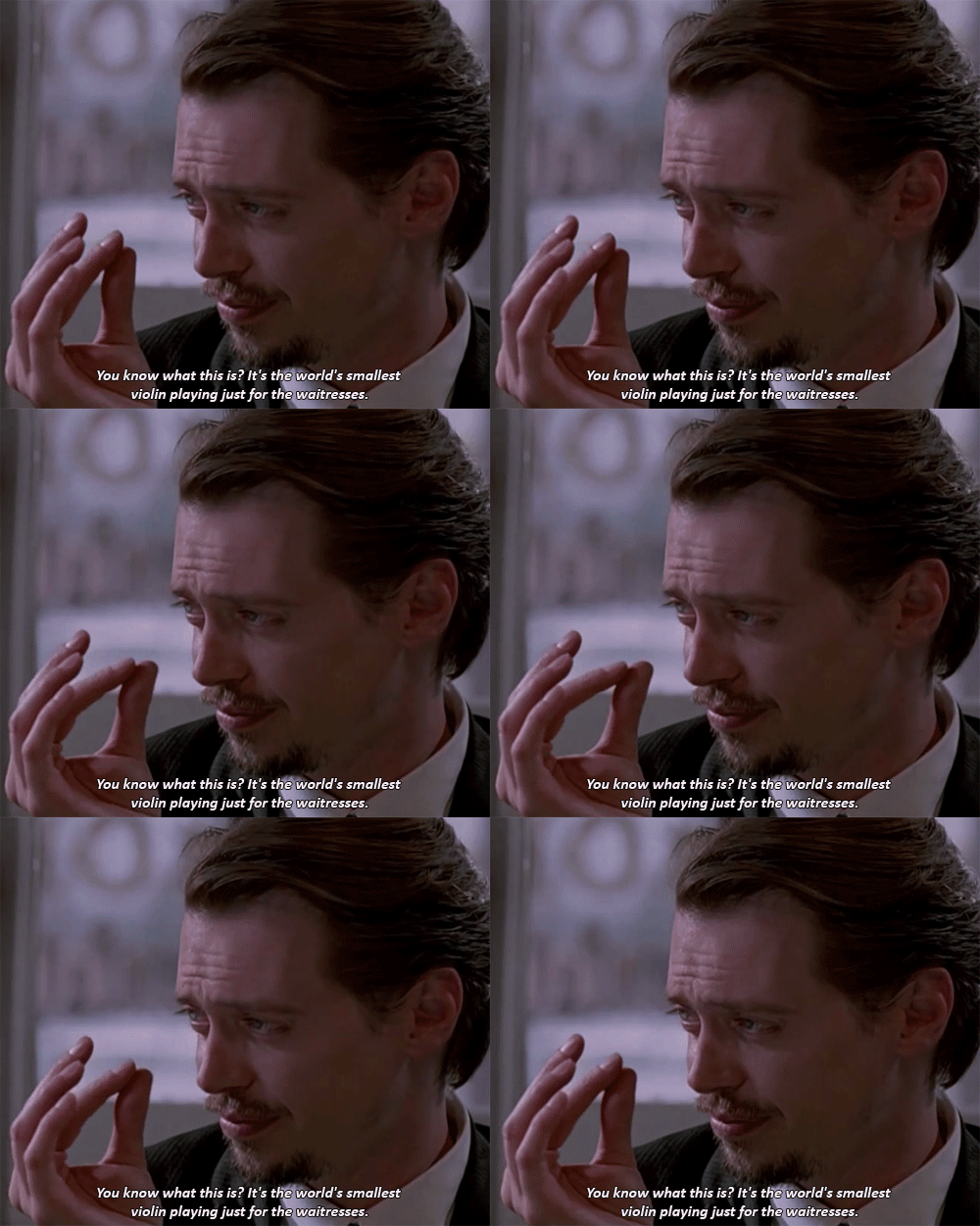
Just to start things off, this prompt reminds me of that classic scene from Reservoir Dogs where Steve Buscemi's character is explaining why he doesn't tip waitresses. While Mr. Pink recognizes waitressing as a real, stressful job, his point is that only servers who do an especially good job deserve a tip. So it isn't exactly the same concept, but kind of similar. Having read a few other blogs, it seems as though everybody is on the same page: working in the restaurant business is no easy task, and these workers should earn as much respect as any other Joe Schmo working any other random job. While I agree to an extent, I guess I'll play devil's advocate for a quick sec.
My sister is currently a waitress, and has been for a number of years. While she is extremely qualified and knowledgeable, I don't think she is very happy doing what she is doing. Nor do I think she wants to be a waitress for the rest of her life. She is constantly unhappy with working conditions, pay, and management. Due to monetary concerns, her need to work two jobs has cut in to time she could be using to go back to school and earn her degree. I'm not saying she has to go to school to be successful and happy, but earning her degree in something that she truly enjoys has been her end goal for a while. Without diving too much deeper into my sister's personal life, here is the deal for her and a lot of other waitresses: Serving is not something they want to be doing for the rest of their lives, isn't always the most secure way to earn a living, and might be the only way for them to earn enough money to continue their education. I'm not speaking for all waitresses, just some. Being that many of these people have not had an opportunity to finish school, or simply do not desire to earn a degree, I think the assertion that some servers lack the education needed to be knowledgeable in many different fields is true to an extent.
Now, before I'm burned at the stake, let me explain. None of what I said above is a bad thing. Knowledge is relative, and any occupation that somebody wishes to hold is valid. While it may be possible that waitresses might not know as much about the stock market or business trends, for example, it is likely that they have a higher emotional intelligence than most and understand how to interact with people in intricate ways. Again, these are all examples (maybe there are a lot of waitresses who are good with stocks, I have no idea). Anyway, what I mean to say is that every job has its pros and cons. Its all about the individual in question. What is their end goal? What makes them happy? What skills do they value? That's all that matters.
I disagree with the idea that waitressing is an inferior occupation. This is not to say, however, that I am disgusted with and completely reject anybody who holds this idea. Just like waitresses have the right to serve and be happy, people have the right discuss the merits of certain occupations. If some guy tells me that being a waitress is less important than being a doctor, NASA researcher, teacher, or firefighter, I can't say I'm going to be up in arms. However, I do know that there is no definitive answer, and once again, it all depends on the person and their values. I also know that being a waitress requires extensive memorization, being able to handle extremely stressful situations, and maintaining a certain level of energy and emotion for extended periods of time. It is not easy to be a good server by any stretch of the imagination, and it requires hard work and practice. Just like all other occupations. Similar to many other current issues, this one can only be solved by acceptance. There is no right or wrong. Or maybe people will just have to agree to disagree.
My sister is currently a waitress, and has been for a number of years. While she is extremely qualified and knowledgeable, I don't think she is very happy doing what she is doing. Nor do I think she wants to be a waitress for the rest of her life. She is constantly unhappy with working conditions, pay, and management. Due to monetary concerns, her need to work two jobs has cut in to time she could be using to go back to school and earn her degree. I'm not saying she has to go to school to be successful and happy, but earning her degree in something that she truly enjoys has been her end goal for a while. Without diving too much deeper into my sister's personal life, here is the deal for her and a lot of other waitresses: Serving is not something they want to be doing for the rest of their lives, isn't always the most secure way to earn a living, and might be the only way for them to earn enough money to continue their education. I'm not speaking for all waitresses, just some. Being that many of these people have not had an opportunity to finish school, or simply do not desire to earn a degree, I think the assertion that some servers lack the education needed to be knowledgeable in many different fields is true to an extent.
Now, before I'm burned at the stake, let me explain. None of what I said above is a bad thing. Knowledge is relative, and any occupation that somebody wishes to hold is valid. While it may be possible that waitresses might not know as much about the stock market or business trends, for example, it is likely that they have a higher emotional intelligence than most and understand how to interact with people in intricate ways. Again, these are all examples (maybe there are a lot of waitresses who are good with stocks, I have no idea). Anyway, what I mean to say is that every job has its pros and cons. Its all about the individual in question. What is their end goal? What makes them happy? What skills do they value? That's all that matters.
I disagree with the idea that waitressing is an inferior occupation. This is not to say, however, that I am disgusted with and completely reject anybody who holds this idea. Just like waitresses have the right to serve and be happy, people have the right discuss the merits of certain occupations. If some guy tells me that being a waitress is less important than being a doctor, NASA researcher, teacher, or firefighter, I can't say I'm going to be up in arms. However, I do know that there is no definitive answer, and once again, it all depends on the person and their values. I also know that being a waitress requires extensive memorization, being able to handle extremely stressful situations, and maintaining a certain level of energy and emotion for extended periods of time. It is not easy to be a good server by any stretch of the imagination, and it requires hard work and practice. Just like all other occupations. Similar to many other current issues, this one can only be solved by acceptance. There is no right or wrong. Or maybe people will just have to agree to disagree.
Tuesday, October 4, 2016
My New Identity Kit
I still haven't gotten a new computer so I'm spending today in the library, once again. I'm not in a rush this time though, and I have 193 minutes left of access on the lib computer. That should be plenty. I identified strongly with Mrs. Flewelling's blog/prompt as I too am an introvert. I pretty much always prefer to sit back and let others do the talking in a large group setting, and I definitely still get a bit nervous in social situations. I used to be fine with this in high school, but college is a whole different world and recently I've been trying my best to step out of my comfort zone.
High school was a much more simple time. I had my set group of friends, and all I really cared about was food, video games, and getting decent grades. That's pretty much been my entire life up until college. I wasn't really concerned with who I talked to at school that day, what clothes I had on, or what party was happening that weekend. I was concerned with getting home before either of my parents so I could play Call of Duty and shoot virtual soldiers online with my friends (the rule was that I couldn't have any "screentime" during the week days as an incentive for me to do well in school). Once I heard the garage door opening, I would rush to turn off the TV and the Xbox, grab a snack, and head upstairs to do whatever homework I had. Once I completed the productive part of the night I would watch YouTube videos and text friends for the rest of the night. Wash, rinse, repeat.
Once I arrived at SDSU and got a feel for the how the social scene operates, I felt out of place. I wanted to have fun and meet new people, but this was hard for me. The introvert in me kept telling me to lay low and keep to myself, but the more social, practical part of me told me that I would be happier putting on a different persona and experimenting with actually talking to new people. It was time to mushfake it until I make it. I would try to pump myself up mentally everyday before leaving my dorm room, and make a conscious effort to be friendly and talkative. This worked in the sense that I made a decent amount of friends, and I am currently far more competent socially than I was in high school. However, I still don't really think I've "made it". I have not fully eased into that more outgoing side of myself, and recently I have been thinking about the fine line between being somebody I'm not, and actively practicing becoming more confident in social situations. I understand that I am introverted and somewhat shy, and I also understand that there's nothing wrong with that. But I know that I would be a happier, more fulfilled person if I worked toward building more meaningful relationships. I guess I've been struggling with this for a while now, but I only really became conscious of it as of late. I think this is something I will eventually figure out, but until then, I will continue to mushfake.
The great thing about the struggle I'm having with my new identity kit is that I have complete control over the outcome. As long as I continue to surround myself with people I like and utilize my support system (my family, mostly) I can find the actual identity that I'm looking for.
Another example of a time where I had to create a different identity was when I coached 8th grade girls volleyball. I had never coached in my entire life, nor had I been in a position of power that involves telling other people what to do. It took a while to get used to, and even though I didn't really want to assert myself and create the presence that a coach might have, I worked toward establishing myself as Coach Spoden, rather than the modest figure the girls would have seen me as if I had been a person they randomly encountered. It was tough, but I slowly grew into the role and it ended up being a very rewarding experience.
I wrote this blog about twice as fast as I wrote the last one. Damn. It's probably because I've been thinking about all of this a lot recently so its fresh in my mind. But it feels good to get it all out and clear my mind before I start on other homework. And hopefully meet with one of my friends who knows a lot about computers to discuss what kind of laptop I should get. Idk though I'm getting kind of used to these library computers.
High school was a much more simple time. I had my set group of friends, and all I really cared about was food, video games, and getting decent grades. That's pretty much been my entire life up until college. I wasn't really concerned with who I talked to at school that day, what clothes I had on, or what party was happening that weekend. I was concerned with getting home before either of my parents so I could play Call of Duty and shoot virtual soldiers online with my friends (the rule was that I couldn't have any "screentime" during the week days as an incentive for me to do well in school). Once I heard the garage door opening, I would rush to turn off the TV and the Xbox, grab a snack, and head upstairs to do whatever homework I had. Once I completed the productive part of the night I would watch YouTube videos and text friends for the rest of the night. Wash, rinse, repeat.
Once I arrived at SDSU and got a feel for the how the social scene operates, I felt out of place. I wanted to have fun and meet new people, but this was hard for me. The introvert in me kept telling me to lay low and keep to myself, but the more social, practical part of me told me that I would be happier putting on a different persona and experimenting with actually talking to new people. It was time to mushfake it until I make it. I would try to pump myself up mentally everyday before leaving my dorm room, and make a conscious effort to be friendly and talkative. This worked in the sense that I made a decent amount of friends, and I am currently far more competent socially than I was in high school. However, I still don't really think I've "made it". I have not fully eased into that more outgoing side of myself, and recently I have been thinking about the fine line between being somebody I'm not, and actively practicing becoming more confident in social situations. I understand that I am introverted and somewhat shy, and I also understand that there's nothing wrong with that. But I know that I would be a happier, more fulfilled person if I worked toward building more meaningful relationships. I guess I've been struggling with this for a while now, but I only really became conscious of it as of late. I think this is something I will eventually figure out, but until then, I will continue to mushfake.
The great thing about the struggle I'm having with my new identity kit is that I have complete control over the outcome. As long as I continue to surround myself with people I like and utilize my support system (my family, mostly) I can find the actual identity that I'm looking for.
Another example of a time where I had to create a different identity was when I coached 8th grade girls volleyball. I had never coached in my entire life, nor had I been in a position of power that involves telling other people what to do. It took a while to get used to, and even though I didn't really want to assert myself and create the presence that a coach might have, I worked toward establishing myself as Coach Spoden, rather than the modest figure the girls would have seen me as if I had been a person they randomly encountered. It was tough, but I slowly grew into the role and it ended up being a very rewarding experience.
I wrote this blog about twice as fast as I wrote the last one. Damn. It's probably because I've been thinking about all of this a lot recently so its fresh in my mind. But it feels good to get it all out and clear my mind before I start on other homework. And hopefully meet with one of my friends who knows a lot about computers to discuss what kind of laptop I should get. Idk though I'm getting kind of used to these library computers.
Tuesday, September 27, 2016
Discourse Communities
Even though this has nothing to do with the topic at hand, I like to start my blogs off with a little check-in so that you guys have an idea of what frame of mind I'm in while writing my response. Not two hours ago I spilled water on my laptop and it won't turn on, so now I'm sitting in the computer lab at the library pounding on the keyboard as fast as I can so that I might finish this blog and start studying for midterms. This week just got a whole lot more stressful.
Given my hurried nature, I have made the executive decision to skim the Swales article rather than giving it an in-depth look. One common theme seems to be that nobody has an ideal definition for discourse community. This is strange to me considering there are six defining characteristics. I feel like somebody smart should have come up with one by now. The definition of discourse is "written or spoken communication or debate", and the three best definitions of community are "a group of people living in the same place or having a particular characteristic in common", "a feeling of fellowship with others, as a result of sharing common attitudes, interests, and goals", and "Community is an American television sitcom created by Dan Harmon that premiered on NBC on September 17, 2009". Can I just write the rest of this blog on the show??? That would be so much easier.
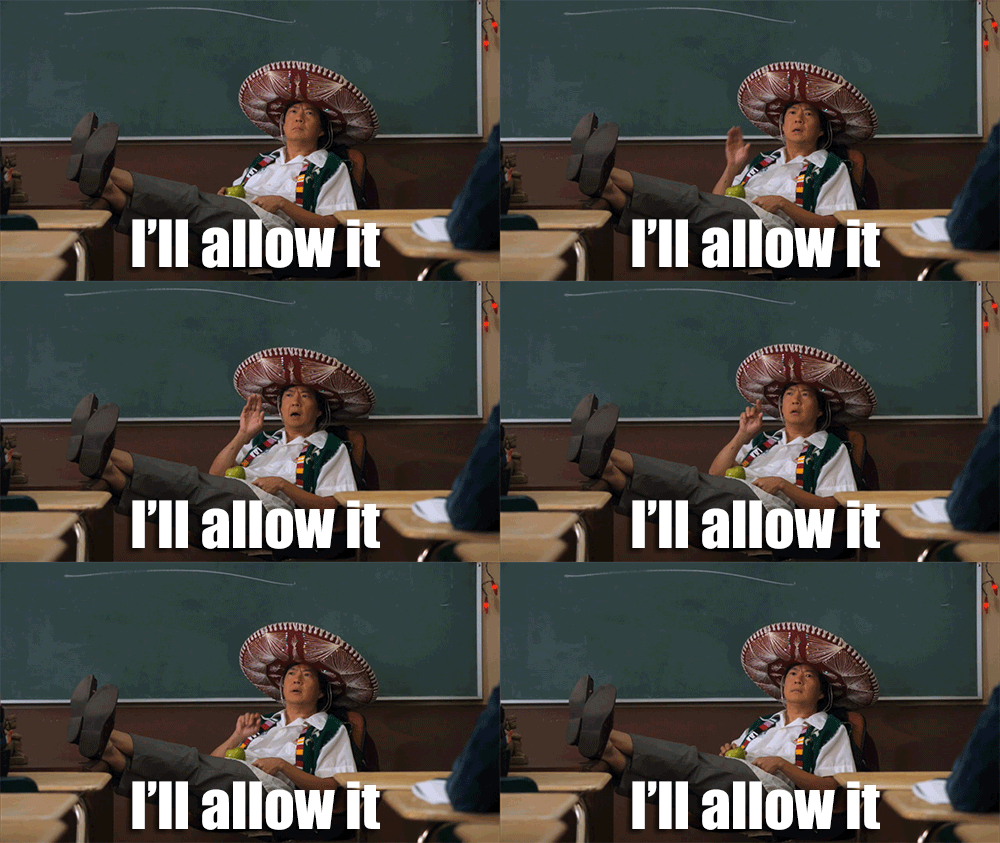
Thanks, Chang. So, Community is a comedy set at a community college in the fictional town of Greendale, Colordao, and follows a group of.... Alright I'm done, back to thinking. If you look at the definitions and combine them, a discourse community is a group of people with similar characteristics who communicate shared ideas and attitudes to achieve a common goal. I'm not sure if this is entirely accurate, but I think its the closest I'm going to get and seems to fit all six characteristics.
Having played and watched sports my entire life, the first example of a discourse community that comes to mind is a team. I will use a basketball team as an example and go through all six defining characteristics. First, a discourse community has a broadly agreed set of common public goals. The main common goal for a team, obviously, is to win. You will rarely find a player who does not want to win, unless they are solely interested in padding their statistics, in which case they are playing for the wrong reason. More specifically, the goal is to win enough to make it to the next round of play, which in this case would be the playoffs and then the championship. Secondly, a discourse community has mechanisms of intercommunication among its members. For a basketball team, it is important to establish at least a basic level of camaraderie so that the players will mesh and stay on the same page. The players must be able to communicate with each other in a way that is specific to what they want to accomplish. This is where the coach comes in to play. The coach will go over certain plays in practice with specific names, and later tell the players to run said plays in game. In all likelihood, the other team will be caught off guard because they are not a part of the same discourse community.


Even though I had a pretty elementary understanding of what a discourse community is going in to this blog, relating it to something familiar helped me to create a clearer picture. This blog actually took me longer to write than intended, but that's ok because I enjoyed temporarily distracting myself from the $1,000 I just lost as the result of knocking over a cup. I hope you guys enjoy reading this blog almost as much as I enjoy researching new laptops while simultaneously attempting to study for two exams. Cheers!
Sunday, September 11, 2016
Opinions
Given that its Sunday, most of my day has revolved amount me stocking up on groceries and watching football and gearing up for classes tomorrow and being tired. That being said, my thoughts might be a bit more scattered and the point a little less clear but the great part about a blog is that it doesn't matter.
In one way, I'm happy that most of the articles are politically based because I'm interested in politics and I'm not as informed this year as I should be or want to be. In another way, this election is such a cluster f that its hard to know what sources to trust.
 Similar to what Tali Sharot and Cass R. Sunstein stated in "Why Facts Don't Unify Us", the media has created an absurd amount of polarization this election. Both candidates are being demonized to an extreme without much coverage regarding actual policies or why each candidate would be a good fit for office. This is why I enjoyed reading the aforementioned article, as well as "Trump's history of corruption" by Paul Waldman. Both covered topics that go against the norm and bring up ideas not generally discussed by the mainstream media. Sharot and Sunstein create both ethos and logos by including several statistics and studies in their article. This way the audience knows that the assertions aren't solely opinion based and actually hold some water. I thought that it was a bit lacking in pathos, however, as there didn't seem to be much emotional drive. It was a pretty steady, factual piece that brought up some great points but honestly didn't feel that personal. Waldman, on the other hand, went with a much different approach. He appealed to the readers' emotions by detailing Donald Trump's blatant history of corruption and why we should be enraged that Hillary is receiving anywhere near the amount of flack as him. Flip the coin and you'll see that his article did not include many statistics to back up his claims, making it difficult for me to see him as a credible author with carefully researched examples. This isn't to say he made everything up, just that I thought the piece needed a little more reinforcement.
The last article I read in the way of op-eds was "Criminal rape cases should not be on a ticking clock" by Gloria Allred. What interested me most about this article was that it seems like a large majority of people would completely agree with the argument that Allred is making. Why would you ever put a time limit on how long somebody has to press rape charges? It seems to me that 95% of people who aren't rapist defendants would agree with this assertion. However, it also seems like most people (myself included) would be completely oblivious to this problem in the first place. Even though my core beliefs weren't swayed in any way, this op-ed introduced me to a new way of thinking about our legal system and what changes need to be made.
As for JSTOR, I read "How Does the Language of Headlines Work?", "Viral Black Death", and "Where American Public Schools Came From". These articles went more in-depth and utilized more research and examples to get their points across. Being a fan of history (I know, common theme in this class), I thoroughly enjoyed reading about the roots of our public school system. The article was very brief, but not to a fault. The writing was concise and painted a clear picture in my mind regarding the evolution at hand. Although only one source was used, the piece was pretty much a history lesson and only needed one to get its point across, in my opinion. The other two were longer, more example-filled commentaries, one relating to an extremely poignant current event and the other a look into the world of headlines. I believe both of these articles did an especially good job utilizing all three of the Big 3: ethos, logos, and pathos. They both used colorful language to stress the importance of each topic, while maintaining credibility through the use of research and examples. Like "Criminal rape cases should not be a ticking clock", I gained insightful knowledge surrounding important topics, without the pieces being overly opinionated.
Overall, while both genres were equally enjoyable for me to read, there were some clear differences. The op-eds were much shorter and more opinionated, while utilizing a more casual approach. The JSTOR Daily articles had a more academic feel to them and relied less heavily on opinions. I think both are important, effective ways of communicating thoughts and ideas relevant to today. The op-eds are great discussion starters and ways for people to gain a perspective contrary to their own, while JSTOR offers a more scholarly way of gathering facts that might support or disprove an argument at hand. I must say, I enjoyed this week's reading far more than last week's and hope to further spark my curiosity by diving deeper into these genres.
In one way, I'm happy that most of the articles are politically based because I'm interested in politics and I'm not as informed this year as I should be or want to be. In another way, this election is such a cluster f that its hard to know what sources to trust.

The last article I read in the way of op-eds was "Criminal rape cases should not be on a ticking clock" by Gloria Allred. What interested me most about this article was that it seems like a large majority of people would completely agree with the argument that Allred is making. Why would you ever put a time limit on how long somebody has to press rape charges? It seems to me that 95% of people who aren't rapist defendants would agree with this assertion. However, it also seems like most people (myself included) would be completely oblivious to this problem in the first place. Even though my core beliefs weren't swayed in any way, this op-ed introduced me to a new way of thinking about our legal system and what changes need to be made.
As for JSTOR, I read "How Does the Language of Headlines Work?", "Viral Black Death", and "Where American Public Schools Came From". These articles went more in-depth and utilized more research and examples to get their points across. Being a fan of history (I know, common theme in this class), I thoroughly enjoyed reading about the roots of our public school system. The article was very brief, but not to a fault. The writing was concise and painted a clear picture in my mind regarding the evolution at hand. Although only one source was used, the piece was pretty much a history lesson and only needed one to get its point across, in my opinion. The other two were longer, more example-filled commentaries, one relating to an extremely poignant current event and the other a look into the world of headlines. I believe both of these articles did an especially good job utilizing all three of the Big 3: ethos, logos, and pathos. They both used colorful language to stress the importance of each topic, while maintaining credibility through the use of research and examples. Like "Criminal rape cases should not be a ticking clock", I gained insightful knowledge surrounding important topics, without the pieces being overly opinionated.
Overall, while both genres were equally enjoyable for me to read, there were some clear differences. The op-eds were much shorter and more opinionated, while utilizing a more casual approach. The JSTOR Daily articles had a more academic feel to them and relied less heavily on opinions. I think both are important, effective ways of communicating thoughts and ideas relevant to today. The op-eds are great discussion starters and ways for people to gain a perspective contrary to their own, while JSTOR offers a more scholarly way of gathering facts that might support or disprove an argument at hand. I must say, I enjoyed this week's reading far more than last week's and hope to further spark my curiosity by diving deeper into these genres.
Subscribe to:
Posts (Atom)